How we measure the temperatures in clouds of the atmosphere

A rain shower on 24 GHz

On 24 GHz the sky noise depends very much on the humidity in the air, because the water molecules are able to absorb radiation near this frequency, causing them to rotate faster around themselves. This makes observing conditions very dependent on the weather. In the afternoon of Oct. 19, 2019, the 24 GHz antenna was simply left pointed to some empty spot in the sky, and the signal power was continuously recorded. Over the next 6 hours, one could notice already a slow and systematic rise of the sky noise, by about 0.5 dB. But on top of that, came a couple of rain showers between UT 13:00 and UT 15:00. As each shower poured down from its dark cloud which crossed the beam of the antenne, the noise went up by almost 1 dB.
Dark clouds show up quite prominently on 24 GHz, since their higher content in water wapor makes them bright, because water molecules have a strong absorption feature at 22.2 GHz. This is noticeable in two ways: During their passing between the Sun and the antenna, they reduce the solar radio flux. But when we point the antenna at the 'empty sky' near the Sun, we can measure the thermal emission from the cloud itself. A period of pretty awful weather can be used to measure the physical temperature of the rain clouds. The theoretical background is the same as in Earth atmosphere: The received radio flux (expressed in antenna temperature) from the Sun is reduced by the absorption of a cloud of optical thickness τ (greek letter 'tau')
T = T0 * exp(-τ)
where T0 is the antenna temperature of the unobscured Sun. This cloud also emits thermal radiation whose strength depends on its temperature Tcloud and its optical thickness: The antenna temperature is
T = Tcloud * (1 - exp(-τ))
This formula has two limiting cases: The emission of a rather transparent cloud ('optically thin' τ ≪ 1) increases with its optical thickness
T = Tcloud * (1 - exp(-τ)) ≈ Tcloud * (1 - (1-τ)) = Tcloud * τ
Thus the measurable antenna temperature depends on the product of the clouds temperature and its optical thickness: If we knew the cloud temperature, our measurement would give us the optical thickness; conversely if we knew the optical thickness, we would be able to determine the temperature of the cloud. In the other case of an opaque viz. optically thick cloud (τ ≫ 1), the solar radiation is blocked, but the power of the radiation emitted by the cloud itself depends only to its physical emperature: T = Tcloud since exp(-x) → 0 for large x. A measurement will give us directly the cloud's temperature.
This means that a more transparent cloud reduces the solar signal by a small amount and emits also only a weak signal. An opaque cloud will strongly block the sun, but is also visible as a source in the sky which is brighter than the blue sky. As a rough border between the optically thin and thick regimes we may use τ = 1. This corresponds to an attenuation of the solar signal by 10*log10(exp(1)) = 4.343 dB.

On a miserable day ...

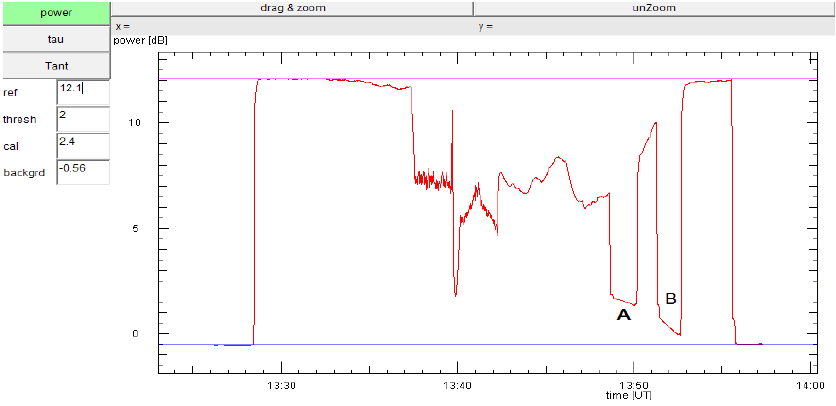
July 27, 2015 was an overcast day, but I wanted some position measurements for the 24 GHz dish, and started tracking the Sun. The raw data are shown here: The Sun's signal appeared to be stable and useful. At UT 13:38 I started a measurement of the true position of the Sun, despite a slight decrease of the signal. But as the signal level changed more strongly, I gave up at UT 13:42 ... By then the solar signal dropped by more than 4.3 dB below its normal level, it was clear that a large and wet cloud was passing. The weakness of the Sun's signal would give a measure of the cloud's optical thickness. So, I pointed the antenna at two instances, A and B, about 5° east of the Sun, in order to also measure the cloud's thermal emission.
Note that before and after this event the Sun's signal was the same: 12.1 dB (indicated by the magenta line). Likewise the noise of the empty sky - a few degrees to the east of the Sun - gave the same background of -0.56 dB (blue line). Thus, we may safely assume that these two parameters remained the same during the whole time, and that these happenings were a relatively short and isolated event.
The radio flux measured from the Sun obscured by a rain cloud is composed of three parts: the attenuated Sun, the thermal emission from the sky and cloud, and the internal noise of the receiver:
p = g * (Tsun * exp(-τ) + Tcloud (1 - exp(-τ)) + Tsys)
with g the factor ('gain') between temperature and the power value indicated by our receiving apparatus.
For the interpretation we consider the results of three measurements: The signal of 12.1 dB from the unobscured Sun is this power:
p0 = g * (Tsun + Tsky(ε) + Tsys)
and the 0.56 dB of the background is this noise power:
backgrd = g * (Tsky(ε) + Tsys)
We also measured as 2.4 dB the ground noise for calibration (290 K):
cal = g * (290 K + Tsys)
While a strict analysis gives complicated formulae, we may (afterwards) convince ourselves that we get sufficiently accurate results, if we neglect the sky noise and background noise against the strong solar signal power:
exp(-τ) ≈ (p - backgrd) / (p0 - backgrd) ≈ p / p0
which means that the ratio of the actual solar signal p and the unobscured level p0 measures the optical thickness at any moment. Using the dB values, this is just a difference
τ = (p0 dB - pdB) /4.343

In the plot we then manually mark appropriate points by blue dots, so that the blue curve interpolates the optical thickness of the cloud for any moment, in particular during the intervals A and B, when we measured the noise from the sky near the Sun.
The final step of the interpretation is to compute the cloud temperature. We measure the sky noise power:
pcloud = g * (Tcloud * (1 - exp(-τ)) + Tsys)
from which we get with approximations as above
Tcloud ≈ 290 K * (pcloud - backgrd)/(cal - backgrd) / (1- exp(-τ))
The plot shows that the temperature at A and B was nearly constant, and close to 300 K - as one might reasonably have guessed.
See DUBUS 1/2016, 70.